
Email Support
info@apesengineering.com
Call Support
+92 42 35307284, +92 3459383782
Clean Agent Fire Suppression System in Pakistan — Complete Guide by APES Engineering
Industries We Cover
- Data Centers
- Corporate Offices
- Telecom Facilities
- Government Projects
- Banks & Financial Institutions
- Healthcare & Education Facilities
Get in Touch
Looking for a reliable Clean Agent Fire Suppression System in Pakistan?
Contact APES Engineering today for professional fire protection solutions that protect your most critical assets.
+92 42 35307284
Safeguarding Critical Assets with Intelligent, Residue-Free Fire Suppression Technology
There are certain spaces inside a building where a sprinkler system simply cannot be the answer to a fire emergency. Imagine a room packed with high-value servers running a bank’s entire digital infrastructure. Picture a hospital’s diagnostic imaging suite, a telecommunications switching centre, a museum’s archival storage room, or a pharmaceutical cleanroom. In these environments, water — the most traditional firefighting tool in the world — would cause as much destruction as the fire itself.
This is precisely where Clean Agent Fire Suppression Systems in Pakistan have become not just a preference, but an absolute necessity.
At Active Power Engineering Services Pvt. Ltd. (APES Engineering), we have been designing and installing clean agent suppression systems across Pakistan for over 15 years. From Lahore’s rapidly expanding commercial districts to Karachi’s industrial corridors and Islamabad’s government and diplomatic quarter, we have protected some of the country’s most critical infrastructure with technology that extinguishes fires in seconds — without leaving a single drop of water, a residue of powder, or a trace of damage to the assets it protects.
This comprehensive guide will walk you through everything you need to know about clean agent fire suppression systems — what they are, how they work, which agents and brands lead the market, and why APES Engineering is Pakistan’s most trusted partner for this specialist fire safety technology.
What is a Clean Agent Fire Suppression System?
A clean agent fire suppression system is an automated fire extinguishing system that uses a gaseous or chemical agent — rather than water, foam, or dry powder — to suppress and extinguish fires. The term “clean agent” refers to the fact that these agents leave no residue whatsoever after discharge. They do not leave water damage, no powdery mess, no corrosive foam — nothing. Once the fire is extinguished and the agent has dissipated, the protected space and everything inside it remain essentially undamaged.
Clean agents work by either removing heat from a fire (cooling), disrupting the chemical chain reaction of combustion, or reducing the oxygen concentration in a space to a level where fire cannot sustain itself — all without creating conditions that are dangerous to human life at the concentrations used for fire suppression.
This combination of effectiveness, speed, and zero collateral damage makes clean agent suppression systems the definitive choice for protecting high-value, mission-critical, and irreplaceable assets.
In the context of Pakistan’s growing economy — where data centres are multiplying, banking infrastructure is expanding, industrial facilities are scaling up, and digital transformation is accelerating — the demand for clean agent fire suppression systems in Pakistan has grown dramatically in recent years, and APES Engineering has been at the forefront of delivering these solutions.
Why Clean Agent Systems are Essential in Pakistan’s Current Landscape
Pakistan is undergoing a significant economic and infrastructural transformation. Businesses are investing heavily in digital infrastructure. The banking and financial sector continues to expand. Pharmaceutical manufacturing is a major and growing industry. Telecom infrastructure is rolling out 4G and 5G networks. Government digitisation initiatives are creating new data centres and IT facilities across the country.
All of these developments have one thing in common: they involve facilities filled with electronic equipment, sensitive data, and high-value assets that cannot be protected by conventional sprinkler systems.
Consider what happens when a sprinkler system activates in a server room. The fire may be extinguished, but the water damage to servers, networking equipment, and stored data could amount to losses far exceeding the cost of the fire itself. Recovery time stretches into days or weeks. Business continuity is shattered. Data may be permanently lost. For a bank, a hospital, or a government department, these consequences are catastrophic.
A clean agent gas suppression system eliminates this secondary damage entirely. The agent discharges, extinguishes the fire within seconds, and then safely dissipates — leaving equipment operational or at worst requiring minor cleanup and inspection rather than wholesale replacement.
Beyond the financial argument, there is a compliance and insurance dimension as well. Insurers providing coverage for high-value electronic assets and critical infrastructure increasingly require or incentivise the installation of clean agent suppression systems. International standards, including NFPA 2001 (Standard on Clean Agent Fire Extinguishing Systems), provide a globally recognised framework that Pakistani businesses with international partnerships or investors are expected to follow.
How Clean Agent Fire Suppression Systems Work
Understanding the operational mechanics of a clean agent system helps appreciate why it is so effective and so safe for both assets and people.
Detection — The Critical First Step
A clean agent suppression system does not operate in isolation. It is always paired with a fire detection system — and the quality and sensitivity of that detection system directly determines how quickly the suppression system responds.
At APES Engineering, we integrate our clean agent systems with the finest fire detection technology available, including the HOCHIKI fire detection system, the VES fire detection system, VESDA by Xtralis, Honeywell by Gent, PEMALL USA, TNA UK, SG Fire System, and SOLOARTI — each selected based on the specific sensitivity requirements and environmental conditions of the protected space.
For clean agent installations, particularly in data centres, server rooms, and other high-risk environments, early detection is everything. This is why aspirating smoke detection technology like VESDA by Xtralis is so frequently paired with clean agent systems. VESDA can detect smoke at concentrations invisible to conventional detectors — identifying a potential fire threat at the very earliest incipient stage, before any visible flame or significant smoke development occurs. This gives the suppression system time to activate and extinguish the threat before it can grow.
The HOCHIKI fire detection system brings Japanese precision engineering to the detection layer, delivering ultra-reliable, low-false-alarm performance in commercial and industrial settings across Pakistan. Similarly, Honeywell by Gent provides intelligent multi-sensor detection that dramatically reduces false activations — critically important in a suppression system context, since an accidental discharge of a clean agent system is both costly and disruptive.
Detection-to-Discharge Sequence
Once fire is confirmed — typically requiring signals from two independent detectors to prevent accidental discharge (a “double knock” logic) — the fire alarm control panel initiates the suppression sequence:
- Pre-Discharge Warning — Audible and visual alarms sound inside the protected zone, warning any personnel present to evacuate. A pre-discharge delay (typically 30 to 60 seconds) allows safe exit.
- Door and Damper Control — Automatic door closers and HVAC dampers activate to seal the protected space, preventing the agent from escaping and ensuring it reaches effective suppression concentration.
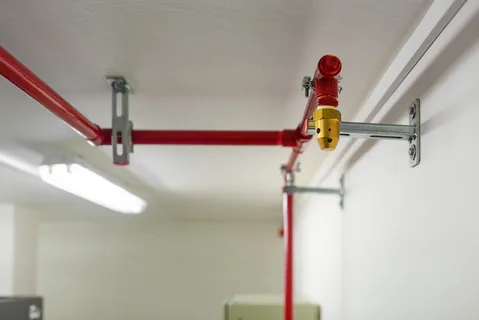
- Agent Discharge — The clean agent is released from pressurised cylinders through a pipe network and nozzles strategically positioned throughout the protected space. Discharge is completed in seconds — typically within 10 seconds for most agents.
- Suppression — The agent reaches the design concentration throughout the space, extinguishing the fire rapidly and completely.
- Post-Discharge Hold — The agent holds at suppression concentration for a design period (typically 10 minutes) to prevent re-ignition.
- Alarm and Response — The fire alarm panel alerts the building’s fire response team, facilities management, and where integrated, emergency services.
Types of Clean Agents Used in Pakistan
Not all clean agents are the same. Different agents have different properties, making them more or less appropriate for specific applications, environmental considerations, and regulatory contexts.
HFC-227ea (FM-200)
FM-200 is the most widely used clean agent in Pakistan and globally. It is a hydrofluorocarbon (HFC) agent that extinguishes fire primarily through heat absorption. It is colourless, odourless, non-conductive, and leaves no residue. FM-200 systems require relatively small cylinder volumes, making them practical for retrofitting into existing spaces with limited room for equipment.
FM-200 is the go-to choice for server rooms, data centres, telecommunications rooms, UPS rooms, and control rooms throughout Pakistan. APES Engineering has installed FM-200 systems in numerous banking facilities, telecom infrastructure rooms, and commercial data centres across Lahore, Karachi, and Islamabad.
Novec 1230 (FK-5-1-12)
Novec 1230, developed by 3M, is a fluorinated ketone that suppresses fire through cooling — absorbing heat directly from the fire. It has an extremely low global warming potential (GWP) compared to HFC agents and an atmospheric lifetime of just five days, making it the most environmentally responsible clean agent available.
Novec 1230 is increasingly specified in Pakistan for clients with strong environmental, social, and governance (ESG) commitments, international partners who require low-GWP suppression agents, and projects targeting green building certifications. It is also preferred for spaces where the highest margin of safety for occupants is required.
Inert Gas Agents — IG-55 (Argonite), IG-541 (Inergen), IG-100 (Nitrogen)
Inert gas systems suppress fire by reducing the oxygen concentration in a protected space from the normal atmospheric level of approximately 21% to around 12-15% — a level at which fire cannot sustain itself but which remains safe for human occupancy for short periods (allowing evacuation).
These agents are completely natural — nitrogen, argon, and carbon dioxide in carefully specified blends — making them zero ODP (Ozone Depletion Potential) and zero GWP. They are preferred for occupied spaces, archive rooms, heritage buildings, and environments where environmental credentials are paramount.
Inert gas systems require larger cylinder banks than chemical agents (due to the volumes of gas required) but have essentially unlimited shelf life and no decomposition products.
CO2 Suppression Systems
Carbon dioxide (CO2) systems are one of the oldest forms of gaseous suppression and remain highly effective for industrial applications — particularly in machinery spaces, printing equipment rooms, and electrical switchrooms where occupancy is normally low or zero. CO2 suppresses fire by displacing oxygen, but at effective suppression concentrations it is dangerous to human life, meaning CO2 systems are strictly reserved for normally unoccupied spaces or total flooding scenarios with robust safety interlocks.
APES Engineering designs and installs CO2 suppression systems for industrial clients in Pakistan while strictly following international safety standards for this technology.
Applications — Where Clean Agent Systems are Used in Pakistan
The versatility of clean agent suppression technology means it is applicable across a wide range of environments. Here are the primary application areas APES Engineering serves across Pakistan:
Data Centres and Server Rooms
This is the single most common application for clean agent systems in Pakistan. As businesses and government departments invest in digital infrastructure, server rooms and data centres are proliferating. These spaces contain the most valuable and irreplaceable assets a modern organisation possesses — its data, its systems, and its digital operations.
We regularly install FM-200 and Novec 1230 systems in data centres across Pakistan, always paired with high-sensitivity detection such as VESDA by Xtralis to ensure the earliest possible warning and the fastest possible suppression response.
Banking and Financial Sector
Pakistan’s banking sector operates extensive IT infrastructure — core banking servers, ATM networks, trading systems, and customer data repositories. Any fire in a bank’s IT room is not just a physical disaster; it is a potential financial and regulatory crisis.
APES Engineering has a strong track record of delivering clean agent suppression systems to commercial banks, microfinance institutions, and financial technology companies across Pakistan. We work alongside our fire detection partners — including Honeywell by Gent and the HOCHIKI fire detection system — to create fully integrated fire safety solutions that protect financial infrastructure to the highest international standards.
Telecommunications Infrastructure
Pakistan’s telecom sector is the backbone of the country’s digital economy. Switching centres, base station controllers, and network operations centres cannot afford a single hour of unplanned downtime — let alone the weeks of recovery that would follow a fire and conventional sprinkler suppression.
Our clean agent installations for telecom clients in Pakistan are designed to protect 24/7 operational environments where human presence may be limited and automated detection and suppression must function flawlessly.
Pharmaceutical and Healthcare Facilities
Pharmaceutical manufacturing facilities in Pakistan face a unique combination of fire risks — from flammable solvents and chemical storage to sensitive automated production equipment and cleanroom environments. Clean agent systems protect manufacturing lines and laboratory spaces without contaminating products or disrupting sterile environments.
In healthcare, imaging suites housing MRI and CT equipment, hospital pharmacies, and medical records archives are all candidates for clean agent suppression. The VES fire detection system and SG Fire System detection ranges are particularly well-suited for integration in healthcare environments, providing reliable, clinically appropriate detection performance.
Industrial Control Rooms and SCADA Facilities
Manufacturing plants, utility operators, oil and gas facilities, and infrastructure operators in Pakistan rely on sophisticated control rooms housing SCADA systems, PLCs, and industrial computers. These spaces must remain operational even during a fire emergency in the broader facility, and their contents are far too valuable to risk with water suppression.
Clean agent systems — often FM-200 or inert gas depending on occupancy requirements — provide the ideal protection layer for Pakistan’s industrial control environments.
Museums, Archives, and Heritage Buildings
Pakistan has an extraordinary cultural heritage. Museums, libraries, and archive facilities holding irreplaceable historical documents, artefacts, and records require the most careful approach to fire suppression. Water, foam, and powder are completely unsuitable. Inert gas systems, which leave absolutely no residue and pose minimal risk to delicate materials, are the preferred choice for heritage protection projects.
APES Engineering is proud to have contributed to the protection of Pakistan’s cultural assets through careful, heritage-appropriate fire suppression design.
Electrical Switchrooms and UPS Rooms
Electrical infrastructure — switchgear rooms, UPS systems, battery rooms, and transformer areas — presents significant fire risks due to high energy densities and the potential for electrical arc faults. CO2 or FM-200 systems are commonly used in these environments, providing rapid suppression capability for electrical fires without the conductivity risks associated with water.
The Role of Fire Detection in Clean Agent System Performance
It bears repeating, because it is so critically important: a clean agent suppression system is only as good as the detection system it is paired with. If detection is slow or unreliable, the suppression system activates too late — or worse, activates unnecessarily due to a false alarm, wasting expensive agent and causing significant disruption.
This is why APES Engineering takes detection system selection as seriously as suppression system design when scoping a clean agent project. Our portfolio of detection brands — spanning HOCHIKI, VES, VESDA by Xtralis, Honeywell by Gent, PEMALL USA, TNA UK, SG Fire System, and SOLOARTI — gives us unmatched flexibility to specify precisely the right detection technology for each environment.
For a large data centre in Lahore, we might specify VESDA by Xtralis aspirating detection in the raised floor void and overhead cable trays — the two most common fire origin points in a data centre — paired with HOCHIKI addressable multi-sensor detectors in the main floor area and ancillary spaces.
For a pharmaceutical production facility in Karachi, we might integrate the Honeywell by Gent addressable panel as the master fire alarm system, with PEMALL USA detectors in production areas and VES fire detection system components covering offices and utilities.
For a telecom switching centre in Islamabad, SOLOARTI‘s smart integration capabilities allow us to create a seamlessly connected fire safety and building management ecosystem where the detection and suppression systems communicate intelligently with facility monitoring platforms.
Every detection and suppression design APES Engineering produces is unique — because every facility is unique. We do not offer cookie-cutter solutions. We engineer solutions.
Design Principles — What Makes a Great Clean Agent System
Designing an effective clean agent fire suppression system is both a science and an art. It requires deep technical knowledge, practical installation experience, and a thorough understanding of the specific environment being protected. Here are the core design principles APES Engineering applies on every project.
Room Integrity
This is the single most important factor in clean agent system performance. If a protected space has gaps — under doors, around cable penetrations, through HVAC openings, in raised floor voids — the agent will escape before it reaches the necessary suppression concentration.
APES Engineering conducts or specifies door fan pressure tests (enclosure integrity tests) for every clean agent installation. This test uses a calibrated fan to pressurize the protected space and measure air leakage, allowing precise calculation of whether the enclosure will retain agent at the required concentration for the design hold time. Where gaps are identified, they are sealed before system commissioning.
Agent Quantity Calculation
The amount of clean agent required is calculated based on the volume of the protected space, the target suppression concentration for the specific hazard, the design temperature, and the enclosure integrity results. These calculations follow the methodologies specified in NFPA 2001 or equivalent international standards. Under-dosing means the system may not suppress the fire; over-dosing wastes agent and increases costs unnecessarily.
Nozzle Placement and Distribution
Nozzles must be positioned to ensure uniform agent distribution throughout the protected volume. Poor nozzle design or placement creates concentration gradients — areas where the agent reaches suppression concentration and areas where it does not. Our engineers use hydraulic calculation software to model agent distribution and optimise nozzle selection and positioning for every project.
Cylinder Storage and Manifold Design
Clean agent cylinders must be stored in a location that provides adequate access for maintenance and cylinder replacement while remaining within the pipe length constraints for effective agent delivery. For large installations with multiple hazard zones, manifold systems allow selective zone protection from a shared cylinder bank, improving cost efficiency.
Safety Interlocks
Clean agent systems require robust safety interlocks to prevent accidental discharge. Abort switches allow personnel who hear a pre-discharge alarm to delay discharge while they confirm evacuation. Manual release and isolation controls allow authorised personnel to manage the system during maintenance. All interlocks are designed and installed to applicable safety standards.
Clean Agent System Standards and Compliance in Pakistan
APES Engineering designs and installs clean agent fire suppression systems to internationally recognised standards, ensuring that every installation is defensible from a regulatory, insurance, and due diligence perspective.
NFPA 2001 — The primary international standard for clean agent fire extinguishing systems. This standard governs agent quantities, design concentrations, safety requirements, and testing procedures. APES Engineering’s designs follow NFPA 2001 methodology, particularly for clients with US-standard specifications or international partners.
ISO 14520 — The international standard equivalent to NFPA 2001, widely recognised in Pakistan for projects with European or international specifications.
BS EN 15004 — The British/European standard for gaseous fire extinguishing systems, particularly relevant for projects using TNA UK products or with UK-based clients and specifiers.
Local Regulatory Requirements — APES Engineering ensures compliance with Pakistan’s National Building Code and applicable provincial fire safety regulations, working with local fire departments and regulatory authorities as required for project approvals and certificates of completion.
APES Engineering’s Clean Agent Project Process
Every clean agent project APES Engineering undertakes follows a rigorous, structured approach that ensures quality, compliance, and client satisfaction at every stage.
Consultation and Needs Assessment — We begin with a detailed discussion of your facility, your assets, your operational requirements, and your budget. We listen before we design.
Site Survey — Our engineers conduct a thorough physical survey of the proposed protected spaces, assessing dimensions, construction materials, existing penetrations, HVAC configuration, occupancy patterns, and detection infrastructure.
Hazard Analysis and Agent Selection — Based on the survey, we identify the appropriate clean agent type — FM-200, Novec 1230, inert gas, or CO2 — and confirm the detection system integration requirements.
System Design and Engineering — We prepare complete engineering drawings, hydraulic calculations, agent quantity calculations, and enclosure integrity assessments. Design documentation is submitted for client review and, where required, regulatory approval.
Detection System Integration Design — In parallel, we design or review the fire detection system integration, specifying the appropriate detection technology from our brand portfolio — HOCHIKI, VES, VESDA by Xtralis, Honeywell by Gent, PEMALL USA, TNA UK, SG Fire System, or SOLOARTI — to meet the performance requirements of the suppression application.
Procurement and Quality Assurance — All equipment is procured through authorised distributor channels. We verify authenticity, inspect all materials on arrival, and maintain full traceability documentation.
Professional Installation — Our certified engineers and technicians carry out all installation work to manufacturer specifications and applicable standards. We maintain strict site safety procedures throughout.
Commissioning, Testing, and Certification — The completed system undergoes full functional testing — detection trigger simulation, pre-discharge alarm verification, control panel logic testing, and where applicable, simulated agent discharge or agent concentration verification. We issue a commissioning certificate upon successful completion.
Training and Handover — Facility teams receive comprehensive training on system operation, emergency procedures, manual controls, and basic maintenance requirements. Full documentation is handed over including as-built drawings, test records, and maintenance schedules.
Service Level Agreements — Our SLA maintenance packages keep your clean agent system in full operational readiness year-round, covering annual inspections, cylinder pressure checks, detection system testing, enclosure integrity retesting, and priority fault response.
Maintenance — Protecting Your Clean Agent Investment
A clean agent fire suppression system is a significant investment, and like all critical safety systems it requires regular, professional maintenance to remain effective and compliant.
Key maintenance activities for clean agent systems include:
Annual Cylinder Weight or Pressure Checks — Clean agent cylinders must be weighed or pressure-checked annually to confirm they contain the correct amount of agent. A loss of more than 5% of agent content (for liquid agents) or 10% of pressure (for pressure-stored agents) requires cylinder recharging or replacement.
Nozzle and Pipe Inspection — Nozzles must be clear of obstructions and corrosion. Pipe connections are inspected for leaks or mechanical damage.
Detection System Testing — All smoke detectors, heat detectors, or aspirating detection components integrated with the suppression system are functionally tested per manufacturer and standard requirements.
Control Panel Testing — Alarm logic, release sequences, safety interlocks, abort switches, and notification devices are all functionally verified.
Enclosure Integrity Retesting — Particularly important if the protected space has undergone any modifications — new cable penetrations, HVAC changes, construction work — that may have compromised room integrity.
Battery and Power Supply Testing — Backup power systems for the suppression control panel are tested to verify adequate capacity for the required standby and alarm periods.
APES Engineering’s SLA clients across Pakistan receive all of the above as part of their service agreement, with scheduled visits, documented reports, and direct access to our technical team for any questions or concerns that arise between visits.
Why APES Engineering is Pakistan’s Leading Choice for Clean Agent Systems
Choosing a clean agent fire suppression contractor is a decision that carries serious weight. The system you install will be responsible for protecting your most valuable assets — and potentially the lives of your employees — in the event of a fire emergency. Here is why APES Engineering is the partner you can trust.
15 Years of Specialist Experience — We have been delivering complex fire suppression projects in Pakistan since before the current wave of digital and industrial expansion. Our experience spans data centres, banks, telecom infrastructure, pharmaceuticals, industrial facilities, and heritage buildings. We have seen every challenge this work can present, and we know how to handle it.
Complete Detection and Suppression Capability — Very few companies in Pakistan can offer both detection and suppression design and installation from a single, accountable team. APES Engineering does. Our expertise with HOCHIKI, VESDA by Xtralis, Honeywell by Gent, VES, PEMALL USA, TNA UK, SG Fire System, and SOLOARTI on the detection side, combined with our clean agent suppression engineering capability, means we deliver truly integrated fire safety solutions.
International Standards Compliance — Every APES Engineering clean agent project is designed to NFPA 2001, ISO 14520, or BS EN 15004 as appropriate. We document everything. We test everything. We certify everything.
Nationwide Coverage — From our offices in Lahore, Karachi, and Islamabad, we cover the entire country. Our field teams are locally based, reducing response times and ensuring personal, relationship-driven service.
Transparent and Trustworthy — We will always recommend the solution that is right for your needs, your budget, and your risk profile — not the solution that is most convenient or profitable for us. Our reputation over 15 years has been built on honest, expert advice.
24/7 Support and Rapid Response — Clean agent systems protect mission-critical facilities. When something needs attention, it needs attention now. Our round-the-clock support and SLA commitments ensure you are never left waiting.
Contact APES Engineering — Pakistan’s Clean Agent Fire Suppression Specialists
Protecting your data centre, server room, financial infrastructure, pharmaceutical facility, or industrial control room with a professionally designed and installed clean agent fire suppression system is one of the most important investments you can make in your organisation’s resilience.
Don’t leave it to chance. Don’t trust it to a contractor without the depth of experience, the brand partnerships, and the technical capability to get it right. Talk to APES Engineering.
Head Office — Lahore 2nd Floor, 32-Main Ali Town, Near Ali Park, Raiwind Road, Lahore 📞 (92) 42-35307284
Islamabad Office House #59, Street #81, Sector I-14/4, Islamabad 📞 (92) 51-270 81 24
Karachi Office R-30, Gulshan-e-Qadri, Phase 3, Shah Faisal Colony, Karachi 📞 (92) 323-403 8826
Frequently Asked Questions
Is a clean agent system safe for people?
Yes. The agents used in occupied spaces — FM-200, Novec 1230, and inert gases — are designed to suppress fire at concentrations that are safe for short-term human exposure. Pre-discharge warning systems give occupants time to evacuate, and automatic door closers and abort switches provide additional safety layers.
What happens to the agent after discharge?
Chemical agents like FM-200 and Novec 1230 dissipate naturally and are ventilated from the space after the suppression event. They leave no residue on surfaces or equipment. Inert gases simply dilute back to atmospheric concentrations as ventilation is restored.
Can a clean agent system be recharged after discharge?
Yes. Cylinders are recharged or replaced by the system supplier or manufacturer. APES Engineering manages the recharge process for our clients, minimising downtime and ensuring the system is returned to full readiness as quickly as possible.
Do I need planning permission or regulatory approval for a clean agent system in Pakistan?
For most commercial and industrial installations, the fire safety design will form part of the broader building fire safety documentation submitted to local authorities. APES Engineering assists clients with all required documentation and liaises with relevant authorities as needed.
How long does a clean agent system last?
With proper maintenance, a clean agent suppression system has a design life of 20 years or more. Many of the older FM-200 systems we service across Pakistan have been in service for 15+ years and continue to perform to specification.